26th September. Wake Me Up When September Ends.....


What a God awful month September is proving to be - at least for me. Those two bastard Ravens that flew over on the 1st seem to have placed some kind of curse on the patch leaving it devoid of anything worthy, certainly a case of 'Nevermore' for the time being. In almost forty visits this month the best that I've managed is 3 Ruff, 4 Little Egrets and today, bird of the month, a Rock Pipit which was my first autumn record here.


To add to my woes Shetland looks set to be sinking under the weight of rares and scarce in the coming days, with Yellow-broweds almost as numerous as the number of 'crews' up there. Which brings me to another moan. Who the f*ck started calling a carload of birders a 'crew'?  When I think of a crew I think of youths wearing tracksuits and bandannas or a ship load of blokes a bit like this:
So as correctly pointed out by Dr Collinson, of the BOU, the correct terminology is a 'carload' or a 'busload' (if more than 5 and over 65). If you use the term 'crew' then you deserve your cars brakes to fail sending you over Hermaness to a salt watery grave.. So don't!!

More gripping than any of the Shetland birds so far has been the abundance of rare pies seemingly concentrated in the Voe area despite rumours (on Twitter) to the contrary. Ryan Irvine (one of the Patchwork founders) tweeted these gripping images of a massive fall of the Johnson and Wood variety.

Embedded image permalink
Having sampled all of the above I wasn't too upset but then he tweeted a picture of a previously undescribed specimen with an Asian influence I was truly gripped:
Embedded image permalink
Showing well

6th September. Another Promising Day

Keeping an eye on the weather through the week suggested that Saturday could be good and Friday would be wet, very wet.

Arctic Tern in the murk
Setting out at dawn it was disappointingly dry, though there had been some rain during the night, but there was a light northeasterly wind and it certainly felt promising, almost as good as skua day (I really need to move on from that). Arriving at the patch I first checked the small lake, surely there would be some waders around the edge - there wasn't. Plenty of gulls on the larger lake, including an adult Yellow-legged and a group of terns, an adult and 3 juvenile Arctics, surely a good sign.

I did two laps of the lakes and as the rain by now seemed set in and the birds just weren't happening I threw the towel in and headed for work.  This was one of my fortnightly Fridays off and I needed to build some time up so at the time it made sense to work - didn't it?
Well no it didn't. Throughout the morning there were messages of inland skuas in Derbyshire and West Yorkshire and clearly I had made the wrong choice.

I left work at 3 getting to Orgreave just after 3:30 where immediately it was clear that birds had arrived. More ducks, 4 Curlew a couple of Snipe and lots of Meadow Pipits. A juv' Arctic Tern and better still a juv Little Gull on the western edge, clearly birds out of the North Sea. Ten Snipe heading high north, a juv Wheatear, 2 Whinchats and a circling Ruff added to the magic of this 60 miles inland 'fall'. But all this left a bitter taste in my mouth - what had I missed? What if I hadn't gone to work and stuck it out in the rain? I'll never know and as seemingly no other local birders were out I didn't suffer being gripped off.


1-5 September. Dog Days

After the excitement of the Long-tailed Skua things gradually reverted to normal i.e. not very many birds.  The less than great birding conditions became frustratingly difficult with an apparent increase in dog walkers flushing everything. After noting the actions of one individual previously in the week - he basically did two laps with the dog constantly barking and disturbing everything - I decided to ask him (politely) if he wouldn't mind avoiding the west bank. To my surprise he was very pleasant and said he would try to keep the dog away. Unfortunately all the time I was chatting to him, the dog playing in the mud, a Dunlin stood no less than 3 foot away literally watching us seemingly unconcerned. The nice dog walker commented on it and I felt a right tit. In future I'm just going to look the other way and let them get on with it - stupid birds.

I did however, in the last couple of weeks, manage another two patch firsts, a Tawny Owl, a couple of Ravens and an eclipse drake Garganey next door on Catcliffe Flash. The flash subsequently enjoyed a purple patch with Bittern (which was seen to fly off over Orgreave) and a Marsh Harrier - maybe it's time to stretch the patch boundary.


24th August. Moves Like Jaeger

Lots of talk during the week about how good the East Coast was going to be over the coming weekend, with some predicting classic fall conditions it seemed that even the hardiest patch workers would up sticks and make for the likes of Spurn and Flamborough. I on the other hand, having just returned from a short break on Anglesey and North Wales couldn't wait to get back to the patch.

Waking at 5am and eventually, after several spells of nodding back off, getting out at 6:30 the conditions looked the stuff of birding dreams - at least they would at one of the East Coast spots; low cloud, rain and a light easterly wind.

No birders present with just a dog walker for company (more on him later) I picked up 3 Common Scoters (2 drakes and a female type) immediately - things were looking promising. I walked along the eastern edge that still, despite the previous nights torrential rain, had a decent muddy edge. As usual I'd opted to leave the scope in the car, I find without it I look more intensely, and scanned through the ducks and gulls.  A small arrival of Teal and 4 Wigeon were another indication that things were moving and as I scanned the southern section of the largest lake I picked up a small dark "gull" sat on the water away from the other gulls.  A voice in my head said "shit Skua!" whilst another said "don't be daft." Fortunately I listened to the former and made my way closer.
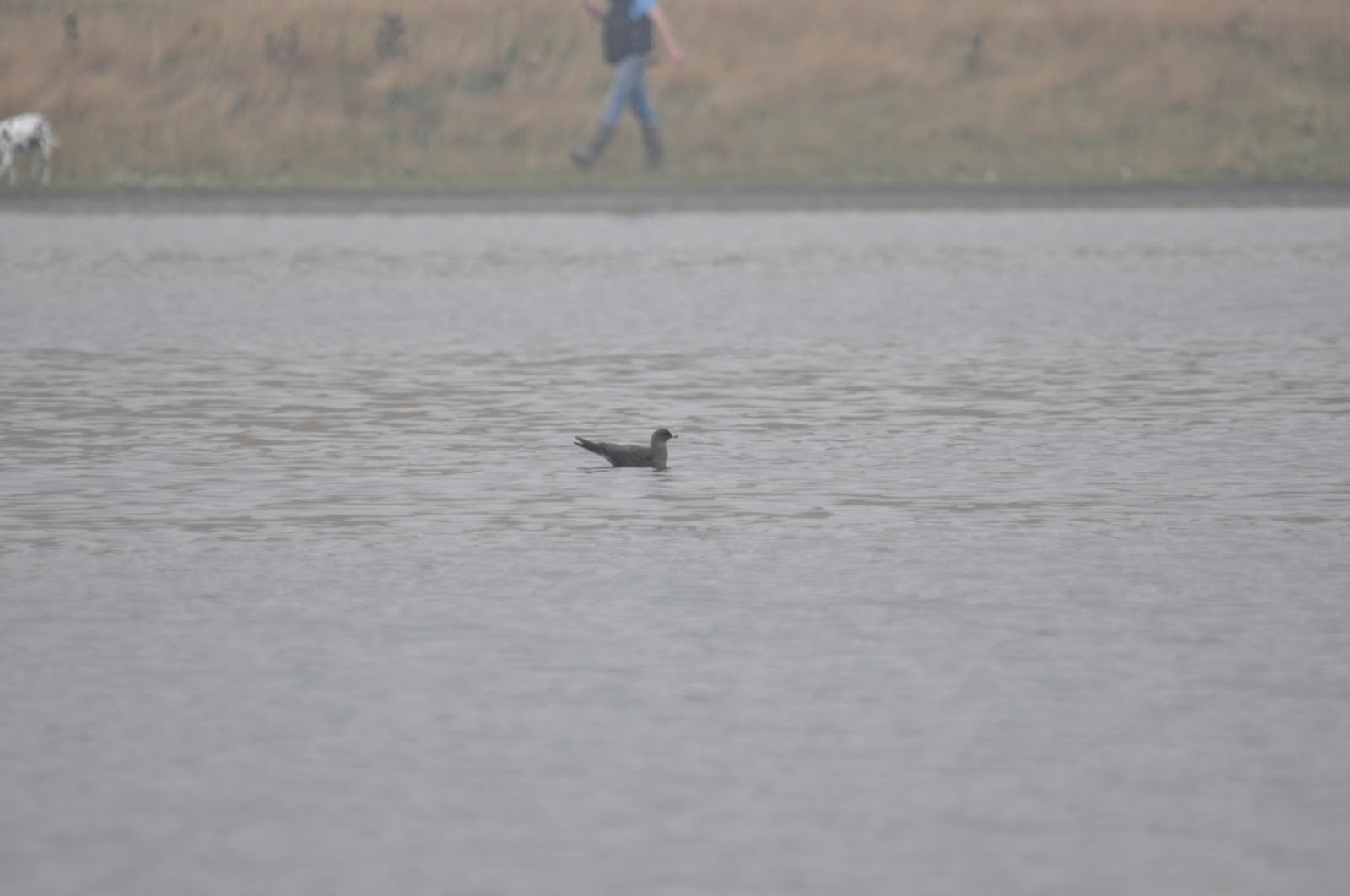
This was pretty much what my initial view looked like.


Obviously a small dark skua I managed to get closer. The bird, a juv, sat there not doing much at all and it was at this point that it dawned on me that this was just as likely to be a Long-tailed as an Arctic.  The sudden panic in me brought on a feeling of nausea and turned my brain to mush whereupon any i.d features that I did know vacated the space between my ears.

Calls to Roy and Andy were greeted by answerphone messages and I settled on getting as many photos, albeit very shakey, as I could.  Fortunately Andy called me back and gave me a few pointers. At this point the Skua started preening revealing the lovely black and white barred undertail coverts of a Long-tailed Skua, I was, by now, 95% certain that that was what this was. Unfortunately for Andy and anyone else wanting to see it the aforementioned dog walker appeared at the waters edge with a bloody great stick. As he raised the stick the gulls on the shoreline got up and took the skua with them. As it drifted south out of site the sickening feeling came over me that I might have to let this one go, though thankfully I'd managed a handful of flight shots that fortunately helped clinch the identification.  Being the techno geek that I am I managed to transfer the shots to my tablet and post them on Twitter and await the response - and more importantly see if I'd cocked up or not. Thankfully Andy sent me a screenshot from the Collins guide which confirmed my suspicions and the rest just like the bird is history..

Note twat with dog and stick

It probably took me an hour or so to calm down after this and with the conditions still good I set about doing another circuit which sure enough paid off with Turnstone, Grey Plover and Whinchat and later Greenshank and a Little Egret.

Another truly spectacular patch day and a species that I never imagined seeing locally. Many thanks to Andy for his assistance at the other end of the phone.

A couple of Clouded Yellows whilst failing to find any scarce passerines.

12th August. Inglorious Bastards

Why the world awaits confirmation that an endangered species, held in a British zoo, might have been successfully artificially impregnated by the hands of man another story at the opposite end of the spectrum slipped by almost unnoticed and certainly without any amount of cooing and awes.

At the hands of a small number of individuals, supported by greedy unscrupulous Grouse Moor managers and owners and helped by short-sighted ignorant politicians the Hen Harrier is now extinct as a breeding English bird. This post from Raptor Persecution Scotland sums up the situation in its succinct title.

There's nothing glorious about the 12th August when the true cost of these 'managed' moors is revealed. The 12th should from now on be a date to celebrate the magnificence of the Hen Harrier. Perhaps with enough pressure we may live to see them grace our moors again, though whilst the likes of senior royals get away with destroying them I won't hold my breath.


31st July. Catch Up.

Not enough time or inclination for blogging over the last few weeks, so a (lazy) run down of what I've been up to, as though anyone actually cared.
Trapped some moths including this smart Canary-shouldered Thorn

Little Gull amongst the Black-heads

Dark variant Peppered Moth
Watched some Dragonflies at Treeton. Fairly certain this is a Ruddy Darter (note the black legs) 
Red-eyed Damselfly

Twitched the Caspian Tern 

A visit to the Doctors revealed high cholesterol levels and we all know what that means :-(

4th August. A Few Good Days

Sooner or later the doldrums of summer would finally break and things would start to happen, or at least that's what I hoped as we said good bye to July and a very fond hello to August and the start (hopefully) of some proper migration.

First in a run of awful photos
There's generally very little of interest during the walk from the bus to the small lake and my main focus is usually to avoid getting mauled by the early morning dog walkers or their dogs! My first scan of the small lake revealed a small duck, among the Gadwall, with what appeared to be a supercilium - interesting.  Indeed it was interesting as it turned out to be the first record of Garganey (a drab female) on the patch earning itself the dubious title as the 170th species recorded here. Only the second addition to the list this year, the first being Jack Snipe.

Thursday had reverted back to stupidly warm and fearing a plague of morons I avoided a return visit in the evening.  Having had a poor nights sleep and waking with a sore throat I was almost tempted to give it a miss and head straight off to work. Fortunately I saw sense and headed out patch bound.  The Garganey had cleared off and generally there was a feeling of nothingness, after a lap of the small lake and a good scan of the large - no Med' Gull among the Black-heads and no sign of a much overdue Little Egret - or was there? I decided rather than do a circular route I'd retrace my tracks and have the benefit of the sun behind me. As I strolled along the causeway - contemplating whether to quit and get an earlier bus - I caught a glimpse of an obvious Egret coming low from the Treeton Dyke side. As I raised my bins it was immediately obvious that this was no little, this was a monstrous Great White, huge bowed wings, Toilet Duck like bend in the neck, long black legs and dangerous looking horn-coloured bill I reached for my camera and nailed some all important record shots as it headed off north, clearly unimpressed with what was on offer.

Unfortunately the camera was on the wrong setting and therefore the shots were even worse than would normally have been.


A Crop of the above shot.

This egret drifted north and an hour or so later turned up (not surprisingly) in the Dearne Valley at Adwick Washlands where it spent the morning.  

With a bit of time before the next bus I walked up the small mound and so I could scan the site and perhaps even pick the egret back up if it changed it's mind. Almost immediately I picked up not one but two egrets coming in from the north. Both obvious Little Egrets they briefly dropped onto the small lake before heading towards Rother Valley. 
Egrets of any species are still scarce around Sheffield - the Dearne Valley getting more than it's fair share - and to my mind this might be the first time that more than one species has occured at the same site on the same day

It has been suggested to me that the YNU (Yorkshire Naturalists Union) might not accept the Great White on the above images - surely you've got to be kidding? 
Little and Great White Egrets as different as Harpic and Toilet Duck


10th July. The Rotherham River Area (not to be confused with riviera)

It's that time of year again when the days are long and the sun shines (sometimes) and there's generally very few birds. Oh birds. Well over the last few weeks there's been more than our normal fair share of ultra rare specimens to chase. Unfortunately I'd either seen them before (Pacific Swift and Bridled Tern), they'd die (Needletail) or just vanish Frigatebird. I'd just booked the ferry when I heard of the Needletails demise and we (thankfully) aborted the trip to Islay for the Frigatebird. So for the rest of June and the first part of July I've been stuck in the garden building things and earning valuable Brownie points that will enable me twitch quality birds like the aforementioned rares.

Meanwhile on the patch I've just about managed to keep visits to 3-4 times most weeks all of which have proved pretty dull, 7 Common Scoter and a Green Sandpiper were the highlights in June with just a Treecreeper (scarce here) so far this month.

Whilst I'm unlikely to win the Patchwork rarest bird find I must surely be in line for oddest patch find with this fine (though broken) example of a Wickes Workbench - not to be confused with the similar Black and Decker Workmate. The very fact that some thoughtful individuals had carried this several hundred metres to lay it in its final resting place brought a feeling of joy to my heart.


The continuing hot spell has really brought the holiday makers out with a group of visiting Eastern Europeans putting on a fine diving display off the top of the Rother Bridge a particular highlight of the recent weekend.

More random (it's what the kids say for unusual) finds this morning included this pink padded bra (34D) and a bust inflatable dingy.                      Hopefully it will piss it down soon and the locals will stay at home watching re-runs of Jeremy Kyle, whilst I feast (visually) on returning migrants, whilst wearing my snug fitting newly acquired pink bra!

9th June. Time To Take Out The Trash!!

As the parentage of the Margate Dusky Thrush continues to court controversy (a bucket load of Canesten won't make this troublesome thrush go away) I find myself in a bit of a quandry. What if this bird had been my 500th? It wasn't my 500th, but on my list of what I do count it was number 499. When I say "what I do count" it is not all, strictly speaking, legit! If it had been 5 0 0 then I would now be in the frustrating position of removing it (at least until the BBRC have ruled on it either way) and continuing to lust for that elusive milestone.

I've always tried to tow the BOU line, though in a few instances I've gone with my heart, or to be more truthful with what some of my peers would consider acceptable. Up until the late 1990's Rob and I were fairly competitive with each other and where we were agreeable we counted certain species that were either not recognised by the BOU or accepted as 'wild' by the BBRC. Rob long since gave up the childishness of twitching and moved to where the birds come to him. I on the other hand still partake in the odd dash around the country, the thrill of seeing a new bird still very strong.

The thrush got me thinking. Perhaps I should remove those questionable birds off my list and remove all possibilities of having a bad taste in my mouth when I hit that magic number - sometime in my mid-50's if my current form is anything to go by!

So here we go time to cleanse my birding soul. As I start this I have a rough idea of what's coming off, but some I expect could be a bit of a surprise and at the end of his I suspect I'll rather wish I had kept the skeletons locked in their cupboard....

Based on the BOU list on BUBO these are the ones that have to go!

Photo by R.Dunn www.richarddunn.blogspot.co.uk 
Lesser Canada Goose: On return from Shetland in October 2005 I called in for a Richardson's type with Barnacle Geese in Northumberland. Good credentials apparently, but the species is yet to be formally added to the list I'll take it off and leave it pending.

Ruddy Shelduck:  The 5 or so birds many saw on the Hayle Estuary in 1994 (whilst en-route to the Scillies) were widely added to many a list including mine.  Of course they were probably feral birds from near Europe.


Baikal Teal: After deliberating for a few weeks I added the Flamborough bird. With that gaping hole in the secondaries it's probably best to see what the 10 Rare Men say now.

Lady Amherst's Pheasant: I never bothered going to see the birds in Bedfordshire, I did see the Halkyn birds several times and counted them. I'm actually happy to leave these on because at the end of the day they're all (though admittedly beautiful bird) plastic and the very fact that the Bedfordshire birds have almost died out is probably due to them never really being self-supporting the relics left being totally reliant on the weird man of the Chalfonts spilling his seed in the woods in order to lure punters down....

Slaty-backed Gull: Still pending with the BOU and given the hybrid possibilities I'll wait and see.

Thayer's Gull: See above.

Alder Flycatcher: Another one pending, but given that some photos were that clear that biometrics could be taken it shouldn't (hopefully) be too long before it goes back on.

Dusky Thrush: Already covered that one!

Mugimaki Flycatcher: Taking this off really hurts, though I guess several reassessments by the BOURC haven't changed the situation and it sits firmly in category D. Arse!

Indigo Bunting: The Wells/Holkham bird of 1988, despite turning up the same day as an East Coast Cliff Swallow and Waterthrush, was deemed unacceptable due to abnormal moult. I couldn't be arsed to go for the Ramsay Island bird in 96', something that I regret a bit - though drab buntings don't float my boat.

So in that short exercise I appear to have wiped out 10 species. Oh hum, I expect four of them will make it back on in time and maybe another Mugimaki will turn up and promote the original one to its rightful place on cat A.

I feel clean now my list is pure BOU, no Irish, Manx, Channel Islands, cage hoppers or birds in cardboard boxes.

Interestingly had I applied the seemingly popular UK400 Club rules I could add an astonishing 19 species, taking me well over 500! Though given that these rules are made by a megalomaniac with absolutely no scientific backing I'll stick to the BOU...

26th May. Two Ticks in The Twilight

Things are really winding down now and movement through the patch has been virtually non-existent in the last week or so, apart from a steady trickle of what I presume are tundrae Ringed Plovers.

Taking advantage of the warm bank holiday weekend and extra day off I paid a late evening visit, a similar visit on the same weekend last year produced Black-necked Grebe and a calling Quail. Much to my surprise I picked up a new bird for the patch as soon as the sun had set - a Red-legged Partridge calling from the top of one of the rock piles. Not the game bird I had hoped for though equally as valuable.


As darkness set in I picked up a distant Barn Owl at the southern end that skirted the grassy edge of the lakes before retreating from a mob of Lesser-black Backed Gulls roosting on the lake. This was a long awaited new addition and one that had taunted me for a while I'd seen them just yards from the site boundary twice before and even found pellets on site.